
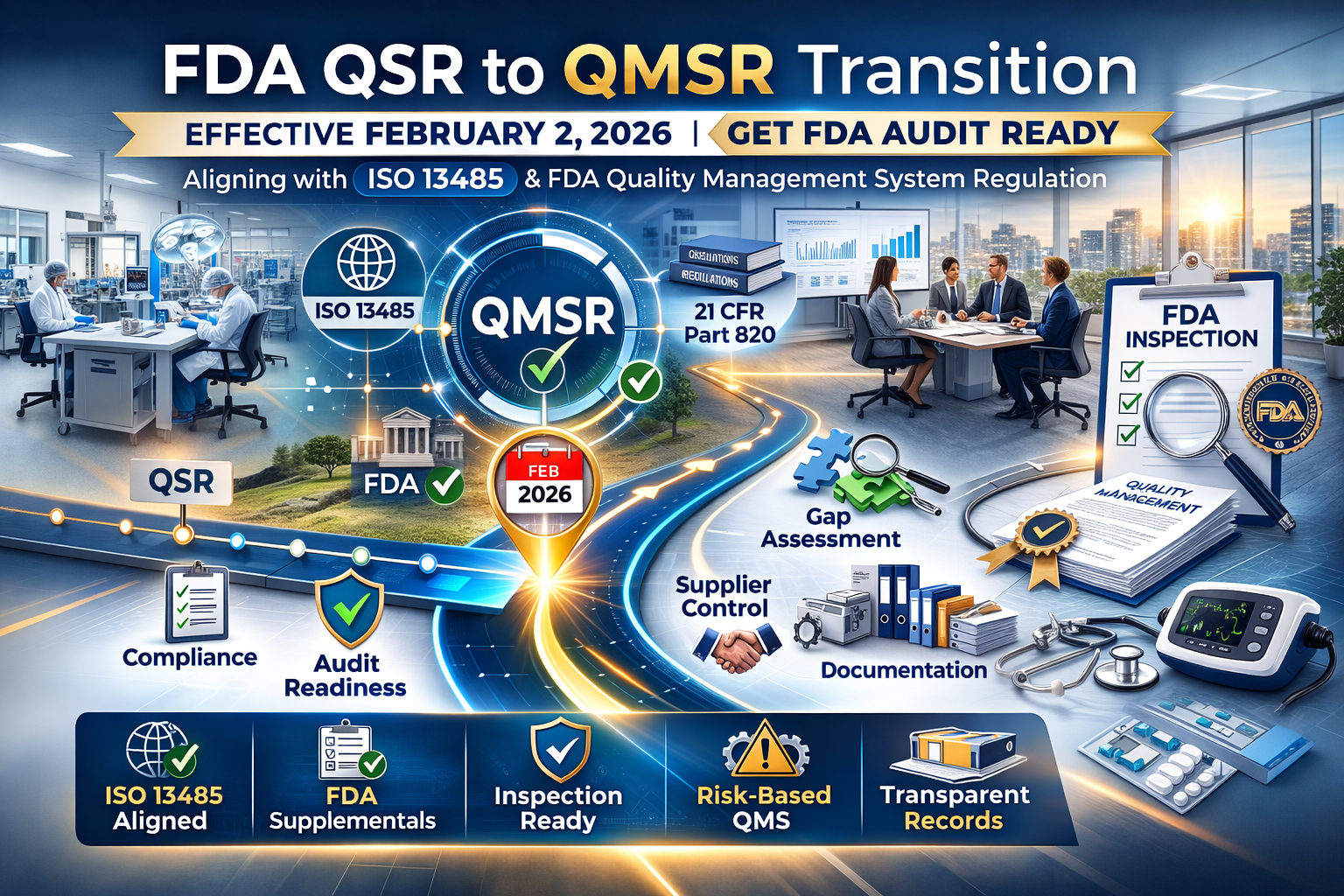
Medical device companies are advised to become audit-ready for FDA inspections under the updated inspection approach outlined in the FDA Quality Management System Regulation (QMSR).
Learn how Bottom Line Results Consulting (BLRC) can assist you.
Schedule your free, no obligation consultation today!
For CEOs, COOs, and Quality Leaders, the winning mindset is simple:
Treat the FDA QMSR transition as an operating system upgrade to your quality
management system (QMS), not a document rewrite. You win by converting your current system into objective evidence that you meet:
- ISO 13485:2016, now incorporated by reference into 21 CFR Part 820 under QMSR (FDA explains this on its QMSR overview page and in the underlying Final Rule in the Federal Register), and
- FDA’s supplemental provisions that remain in Part 820 and sit “in addition to” ISO
13485 requirements (see 21 CFR Part 820 on eCFR and Subpart B Supplemental Provisions).
Why this matters to the business: when quality infrastructure lags, it shows up as delayed releases, stalled submissions, higher quality costs (scrap, rework, investigations), and increased inspection risk. QMSR does not create these problems. It exposes them faster.
What actually changed from QSR to QMSR in plain language:
- QSR (Quality System Regulation) is used to spell most requirements directly in 21 CFR Part 820.
- QMSR (Quality Management System Regulation) still uses Part 820 but makes ISO13485:2016 the core framework by incorporating it by reference and adding a smaller set of FDA-specific supplemental provisions (FDA’s high-level explanation is on the QMSR overview page, and the legal basis is in the Final Rule).
FDA also incorporated Clause 3 of ISO 9000:2015 for terms and definitions, which affects how FDA expects terms to be used during inspections and in records. FDA calls this out on the QMSR overview page.
“We are ISO certified, so we are done” is a trap
ISO 13485 certification is a strong starting point. It is also used internationally and underpins programs such as MDSAP, which is why the FDA pursued harmonization (AAMI explains what “incorporation by reference” means and why ISO 13485 matters globally in this overview).
But ISO certification alone is not automatically “done for FDA,” because Part 820 includes supplemental requirements written explicitly as “in addition to” ISO clauses. The clearest place to see those add-ons is in 21 CFR Part 820, Subpart B.
FDA Inspections changed too
The FDA explicitly states that on February 2, 2026, it withdrew QSIT and initiated the
inspection process described in Compliance Program 7382.850. See the FDA’s QMSR
Frequently Asked Questions and the official CP 7382.850 PDF.
Translation: even if your SOPs look polished, the FDA will follow a program designed for a QMSR world. Your success depends on how quickly you can produce coherent, risk-based evidence across the product lifecycle.
Who needs to care, and why CEOs should own it
If you manufacture finished devices, you must establish and maintain a QMS appropriate to your device and operations. Part 820 also applies to many “partial” manufacturers and outsourced activities, including contract sterilization, relabeling, repacking, and specification development, as stated in 21 CFR 820.10 on eCFR.
The CEO angle is governance and risk.
- Quality is a leadership system. If accountability, resourcing, and management review are weak, QMSR will make that weakness visible during audits and inspections,
- If you outsource manufacturing or key processes, supplier oversight becomes the primary means of inspection. You can outsource tasks. You cannot outsource responsibility.
What “FDA audit ready” looks like under QMSR
Audit readiness under QMSR is best understood as a small number of outcomes that your team can demonstrate on demand:
- Your QMS is aligned with ISO 13485 as required by QMSR, and you can point to how you meet the supplemental Part 820 provisions using the regulation itself as your anchor. See 21 CFR Part 820 and Subpart B.
- You can explain and produce evidence that matches the FDA’s updated inspection expectations described in Compliance Program 7382.850.
- Your leaders and process owners can speak consistently to how quality performance is managed, escalated, and improved, in a way that aligns with the FDA’s QMSR framing in its FAQ.
This is not about creating new bureaucracy. It is about reducing surprises. Fewer surprises mean fewer delays, lower cost of quality, and less disruption to production and commercialization plans.
Turn the FDA QMSR transition into your competitive advantage.
The best teams will use QMSR to do something more valuable than “check the box.”
They will build a QMS that:
- supports consistent execution across functions, shortens investigations and release cycle time
- reduces rework and recurring quality issues
- improves supplier performance and accountability
- holds up under inspection pressure without heroics
Invite BLRC to run a rapid regulatory and QMS diagnostic to identify the fastest path to QMSR inspection readiness and provide you with a detailed gap assessment based on your current QMS state of compliance with the new regulations.